
The short version
AI is genuinely the fastest way to get from an idea to a working demo without hiring anyone. But it doesn't reduce technical debt, it accelerates it: you can now build a month of wrong foundation in a weekend, and it looks like it works. The right model is AI plus human judgment and review, not AI instead of it. Let AI build freely for prototypes, internal tools, and idea validation. Get real engineering in the loop the moment real money, user data, scale, or compliance is involved.
You built a working version of your product over a weekend with AI. Nobody wrote a line of it, real people can click on it, and now you’re quietly asking the obvious question: why would I ever pay an engineer again?
It’s a fair question, and the honest answer isn’t the one either camp wants to give you. The hype crowd says AI has made engineers optional. The doom crowd says AI-generated code is garbage that will collapse the moment you look at it. Both are wrong, and both are trying to sell you something.
Here’s the real version. AI doesn’t remove the need for engineering judgment. It raises the stakes on it. The tools are good enough now that you can build fast in the wrong direction faster than ever before, and it will look like it’s working the whole way down.
I run a technical partnership, and we’ve rescued four builds that went sideways. The failure pattern is almost always the same: a foundation nobody checked, discovered far too late. AI doesn’t change that pattern. It just lets you reach it in a weekend instead of a quarter.
This is the decision article: should I let AI build this at all? If you’ve already built something and you’re wondering what to do with it, that’s a different conversation, and I’ll point you to it at the end.
What AI Is Genuinely Great At
Let me be clear about the upside, because it’s real and it’s large.
AI coding tools are the best thing that has ever happened to a non-technical founder who needs to get to a demo. Full stop. You can go from an idea in your head to something a real person can click on, in days, without hiring anyone or spending a cent on a team. That was impossible three years ago.
Prototypes. If you need to show an investor, a co-founder, or a first customer what you mean, AI will get you there faster than any other route. A clickable version of your idea beats a slide deck every time.
Boilerplate and raw speed. The repetitive, unglamorous scaffolding that used to eat an engineer’s first week (setting up a project, wiring a login screen, building basic forms) is now near-instant. That’s genuine, uncontroversial value.
Exploring an idea. You can build three versions of a concept in the time it used to take to build one, and throw away the two that don’t land. Cheap exploration is a real competitive edge, and AI makes it nearly free.
The best use of AI right now is buying yourself certainty before you spend real money. Prove people want the thing, prove you can explain it, prove the flow makes sense. AI is exceptional at getting you to that proof cheaply. That is not a small thing, it is the whole early game.
None of this is the trap. The trap is what you do next.
Where It Bites
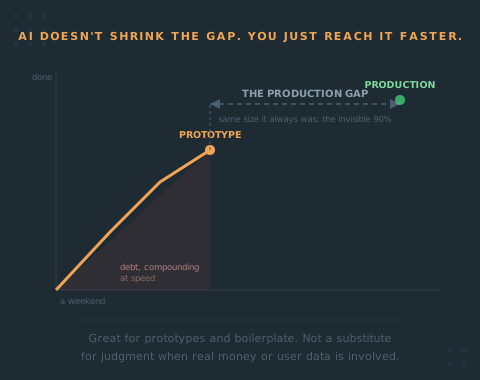
The gap between “this works in a demo” and “this survives real users” is the same gap it has always been. AI didn’t close it. It just lets you reach the edge of it much faster, which means you fall off it much faster too.
Three things sit on the far side of that gap, and they’re exactly the three AI is worst at.
Architecture and system design. AI writes the code in front of it well. It does not hold your whole product in its head and ask “will this structure still make sense at feature number twelve?” Those decisions (how the pieces fit, what depends on what, where the seams go) are the ones that are cheap to get right early and brutally expensive to change later. AI optimises for the feature you asked for, not the ten you’ll ask for next.
Security. This is the one that quietly ends startups. AI-generated apps routinely ship with permission layers that let any user read any other user’s data, secret keys sitting in code that runs in every visitor’s browser, and no protection against someone hammering your systems. None of it shows up in a demo. All of it shows up the moment you have real users and real data.
The invisible 90 percent. Error handling. Edge cases. What happens when a payment half-completes, when two people click at once, when the input is garbage, when the network drops. None of it shows up while you’re the only one clicking around.
Red flag
Working and finished are not the same thing
The most dangerous phrase in AI-built software is “it works.” It works means the path you just clicked did what you expected once. Finished means it holds up when a thousand people who don’t care about your happy path show up at the same time, some of them malicious, some of them confused, all of them doing things you never tested. AI gets you to “it works” in a weekend. The distance to “finished” is where the real engineering lives, and it is not optional if real money or real data is involved.
The Sharp Point: AI Accelerates Debt
Here’s the mechanism behind it.
There’s an old joke in software: days of coding can save you hours of planning. It’s a joke about how developers skip the thinking, build the wrong thing quickly, and pay for it in rework. AI didn’t fix that. It supercharged it.
AI generates new code based on the code that’s already there. So if your foundation has a flawed pattern, that flaw doesn’t stay in one place. It gets copied into every feature built on top, confidently, at a speed no human team could match. You don’t get a codebase that slowly improves. You get one that consistently repeats the same mistake, faster. When we open up a build that stalled, that’s usually what we find: not one catastrophic decision, but one small wrong one, repeated everywhere, too woven in to pull out cheaply.
AI does not reduce technical debt. It accelerates it. You can now build a month of wrong foundation in a single weekend, and the whole time it will look like it is working.
That’s the trap in one sentence. The thing that makes AI feel magical (it never gets tired, it never slows down, it always produces something that runs) is exactly what makes it dangerous without judgment in the loop. A human engineer building the wrong thing gets a nagging feeling by Wednesday. AI has no nagging feeling. It will build the wrong thing beautifully and indefinitely until someone with judgment tells it to stop.
The tool doesn't tell you when you've left prototype territory. You have to know.
This is why “AI instead of engineers” is the wrong model. The right model is AI plus human judgment and review. The AI does the typing. A person decides whether the thing being typed is the right thing, and catches it when it isn’t. Take the person out, and you’ve automated the production of confident mistakes.
You can watch this happen in the specs themselves. We once got an AI-generated brief from a founder, detailed, structured, every edge case covered, describing a system built for hundreds of thousands of users with serious infrastructure. The actual product was a website for a chiropractor. Another time we fed a simple community feature to an AI and it handed back a spec fit for a new Facebook: notifications, emoji reactions, attachments, mentions, threading, moderation, private groups. What we actually shipped was plain comments and threads, enough to learn whether anyone would post at all. AI does not talk you out of scope. It enthusiastically expands it, and expanded scope is the one thing a first version cannot afford.
The Split: When to Let It, When Not To
You don’t need an engineer for everything, and I’m not going to pretend you do. Most of the time the answer is genuinely “let AI build it and don’t overthink it.” The skill is knowing which side of the line you’re on.
Here’s the honest split.
- Throwaway prototypes and clickable demos
- Internal tools only you or your team will use
- Validating whether people want the idea at all
- Nothing irreversible happens if it breaks
- No real customer data is being stored
- Real money changes hands (payments, payouts, billing)
- You're storing personal, financial, or health data
- You expect real scale, not ten friendly testers
- Anything touching compliance or regulation
- It's a foundation you'll build on for years, not weeks
Read the left column again. That covers most of what a founder actually needs in the first few months. Let AI rip. Ship the internal tool. Put the prototype in front of ten people. Don’t call an engineer to bless a throwaway. That would be its own kind of waste.
The right column is where the stakes change. Real money, real data, real scale, real regulation, or anything you’re going to depend on for years. That’s not a place for confident guesses. That’s where a human who has seen these mistakes needs to be in the loop, either building alongside the AI or reviewing what it produced before you commit to it.
The line isn’t about how much code you’ve written. It’s about what you’re about to risk. A founder can cross from the safe column to the dangerous one in a single afternoon by adding a payments button, and the app will look identical before and after. The code didn’t get more dangerous. Your exposure did.
So, Should You Let AI Build It?
Yes, and keep a human in the loop for the parts that matter. That’s the whole answer, and I’ll own our bias while I give it: we’re a technical partner, so of course I think judgment is worth paying for. But I’m not telling you to hire us to build your prototype. I’m telling you the opposite. Use AI, build fast, prove the idea, spend nothing.
The decision itself doesn’t require a checklist, it requires honesty: keep going alone as long as you’re genuinely in the left column above, and the moment you catch yourself in the right one, stop and get a second set of eyes before you build further on top of what’s there. Not a rewrite. Not a team of ten. Often just a person who knows where AI cuts corners, checking the corners.
The founders who get burned aren’t the ones who used AI. They’re the ones who never noticed they’d stopped prototyping and started shipping a real product on a prototype’s foundation. Notice the moment, and you keep every advantage AI just gave you without inheriting the risk that comes with it.
Read next Vibe Coding Your MVP: What Works, What Breaks, and What to Do Next