
The short version
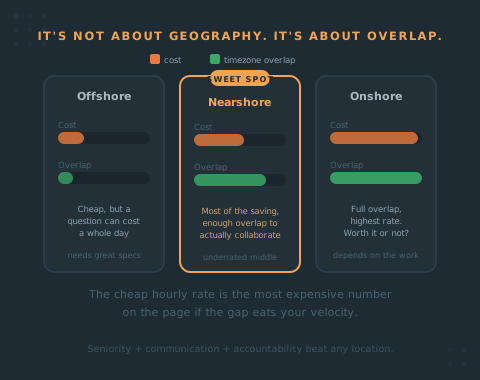
The cheap hourly rate is the most expensive number on the page if a big timezone gap eats your velocity. With zero overlap, one clarifying question can cost a full day, so async-only work needs excellent specs and senior people who don't need hand-holding. Nearshore is the underrated middle: most of the saving, enough overlapping hours to actually collaborate. But this isn't really about geography. It's seniority, communication, accountability, and how well the work can be specified. Offshore works brilliantly with the right setup and fails badly with the wrong one, and so does onshore.
Someone shows you two quotes. One team charges $90 an hour, the other charges $25. The cheap one is on the other side of the planet. The maths looks obvious, so you sign.
Here’s the part the maths hides. The hourly rate is the one number everyone stares at, and it’s usually the least honest number on the page. What you actually pay for is shipped, working software. If a large timezone gap turns one clarifying question into a full day of waiting, your $25 an hour buys you a fraction of the progress it looked like it would. The rate went down. The cost per outcome went up.
The trade-offs that actually decide this come down to a handful of things, and then a reframe that matters more than any of them: this was never really about geography.
The gap is not a detail. It sets how fast you can iterate.
The Rate Is Not the Cost
There are three labels people use, and they mostly describe distance and time difference, not quality.
Offshore. A long way away, usually eight to twelve hours of difference. Lowest rates by a wide margin. Your working day and theirs overlap for an hour at best, sometimes not at all.
Nearshore. A few hours from you, same rough half of the world. Rates well below onshore but above deep offshore. You share a real chunk of the working day, so you can talk when something is unclear instead of waiting.
Onshore. Same country or region as you. Highest rates. Full overlap, same business culture, easiest to sit in a room together, real or virtual.
The rate difference between these is real and large. But the rate is what you pay per hour, not per result. The moment you factor in how the timezone gap affects your ability to correct course, the picture changes.
You don’t pay for hours. You pay for shipped, working software. A cheap hour that produces a day of waiting is not a cheap hour. It’s an expensive outcome wearing a cheap price tag.
Two teams can bill wildly different rates and cost you roughly the same per feature once you account for the overhead the cheaper one quietly adds. That overhead is almost always about communication, and communication is almost always about overlap.
What a Timezone Gap Actually Costs You
Picture a normal moment in any build. The developer hits something ambiguous in the spec. There are two sensible ways to build it and the wrong one means rework.
With full overlap, they ask, you answer, they keep going. Ten minutes lost. With a nine-hour gap and no shared hours, they ask at the end of their day. You read it at the start of yours, hours later, and reply. They see your answer at the start of their next day. One small question just cost a full day of calendar time, and it wasn’t anyone’s fault. It was structural.
Now multiply that by every ambiguity in a real project, which is a lot of them.
A large timezone gap does not slow down typing. It slows down decisions. Every question that needs your input becomes a round trip measured in days, not minutes. If your product still has a lot of open questions, which every early product does, this is exactly where a big gap hurts most.
There is a way to make a big gap work, and it’s specific. Async-only development is viable when two things are both true: the specs are genuinely excellent, so there’s almost nothing to ask, and the people are senior enough to make good calls on their own when something is unclear rather than either guessing badly or freezing. Take either of those away and the gap turns into a tax on everything.
Red flag
When a big gap goes wrong
Junior developers, a vague brief, and zero overlap. The developer can’t ask, so they either build the wrong interpretation and you find out a week later, or they stop and wait, and you lose days to silence. Every misunderstanding costs a full cycle to catch and another to fix. The rate looked cheap. The project took three times as long as the same work with a team you could actually talk to. We’ve been brought in to restart more than one build that stalled exactly here, and the cheap rate was never the thing that saved it.
Nearshore Is the Underrated Middle
Founders tend to frame this as a binary: pay up for onshore, or go cheap and far. The option that gets skipped is the one that quietly wins for a lot of people.
Nearshore keeps most of the cost saving. Rates a few hours away from you are often close to offshore and well under onshore. What you buy back with that smaller gap is the thing that actually protects your velocity: two to four overlapping hours every day. That’s enough for a real standup, a live call when something is unclear, and same-day answers instead of next-day ones.
That overlap is not a nice-to-have. It’s the difference between correcting course in an afternoon and correcting it next week.
- Lowest hourly rate, biggest gap between rate and real cost
- One clarifying question can cost a full day
- Only works with excellent specs and senior, self-directed people
- Course corrections measured in days
- Great when tightly scoped, brutal when the brief is still moving
- Most of the cost saving, without the velocity tax
- Same-day answers, questions resolved inside working hours
- Tolerates the normal ambiguity of an early product
- Course corrections measured in hours
- Live collaboration when you need it, async when you don't
None of this makes offshore wrong. It makes offshore a tool with a narrow, specific job: work that can be fully specified up front and handed to senior people who don’t need you in the loop. When that’s the reality, offshore is excellent value. When it isn’t, nearshore usually costs less once you count the waiting.
It Was Never Really About Geography
Here’s the reframe. Strip away the map and the four things that actually decide whether this works are the same everywhere.
Seniority. Already covered above, repeated here only because it’s the biggest lever of the four.
Communication. Written clarity, plain language, proactive flagging of problems. A great communicator eight hours away beats a poor one down the hall, because the whole cost of distance is communication overhead, and they carry less of it.
Accountability. Do they own outcomes or just hours? Someone who takes responsibility for the thing working will close gaps themselves. Someone billing time has no reason to.
How well the work can be specified. The catch most founders miss: you rarely know how good your own spec is until someone on the other end of a big gap has to act on it without you. If you can’t say with confidence that yours is excellent, treat it as ordinary, and keep the gap small until you’ve proven otherwise.
Offshore works brilliantly with the right setup: senior, well managed, tightly scoped. It fails badly with the wrong one: junior, unmanaged, vague briefs. And that exact same sentence is true onshore. Geography is not the variable. The setup is.
This is why “offshore is cheap” and “offshore is low quality” are both lazy. A senior, well-managed, tightly scoped offshore team will out-deliver an unmanaged onshore one for a fraction of the price. An unmanaged offshore team briefed with a vague paragraph will burn your runway no matter how low the rate is. Same setup, same result, wherever the people sit. Judge the setup, not the map.
If you’re weighing this against bringing someone in directly, the questions that decide a good hire are mostly the same ones: seniority, communication, and accountability travel across every model. The way you read those signals in a first developer applies here too.
An Honest Decision Guide, and Our Bias
So, plainly. If your product is still finding its shape and the brief changes weekly, you need overlap. Go onshore or nearshore, and lean nearshore to keep the cost sane. If your work is genuinely well specified and you have senior people who can run without you, offshore is excellent value and the gap won’t hurt you. If you’re not sure which of those you are, assume the brief will move, because at early stage it always does, and don’t buy the biggest gap.
And know my bias before you weigh it. At Hurricane we run a senior, tightly managed model with real overlap, and we lead the work rather than just billing hours against a spec you wrote alone. So of course I value overlap and seniority. I’m telling you this because I’ve watched the cheap-rate, big-gap version fail founders more than once, and the failure was never about where anyone lived. It was junior people, a vague brief, and no shared hour to fix either.
One more thing, because it reframes the whole question. Onshore versus offshore is really an outsourcing question, and outsourcing in the classic sense is not what we do. A vendor sells you hours in a fixed location, and you pick the least-bad compromise between rate and overlap. We are a remote-first partner, which quietly dissolves that trade-off. We are already distributed, so we organise around your hours instead of asking you to organise around ours, and we adapt as the work changes rather than holding you to a spec you wrote alone. A partner adapts to you. A vendor makes you adapt to them. Pick the relationship first, and the map mostly sorts itself out after that.
The teams that get this right don’t pick a region. They pick a setup: seniority matched to how open the work still is, communication they can actually feel, accountability for outcomes, and only as big a timezone gap as the specs can honestly support. Get that right and the rate stops being a gamble. Get it wrong and the cheapest hour on the page becomes the most expensive line in your budget.
Before you sign anything, run an honest gut check on where your own project actually sits. The cheap rate was never the risk. Buying a gap your specs and your people can’t actually support was.
Read next You're About to Hire a Developer. Here's How Not to Get Burned.