
The short version
When you raise a serious round, an engineer hired by your investors reviews your product before the money moves. They check whether the architecture can scale or needs a rewrite, how you handle user data and security, whether any tests exist, how much technical debt is buried, and whether you can prove you own every line. The two findings that kill deals fastest are IP you can't prove you own and a product that lives entirely in one person's head. All of it is fixable, but only if you start months before the term sheet, not the week after.
There’s a moment in a serious raise that almost no founder sees coming. You’ve done the hard part. The pitch landed, the partners are excited, there’s a term sheet on the table with a number you’re happy with. And then, quietly, before any money moves, your investors hire an engineer to open up your codebase and tell them what they really bought.
You are not in that room. Your code is. It’s sitting there as evidence, being read by someone whose entire job for the next two weeks is to find the reasons this deal is riskier than it looks. This is technical due diligence, and at Series A it’s routine. At a serious seed round it’s increasingly common too.
Most founders walk into it blind, treat it as a formality, and get surprised. We prep founders for exactly this review, and the reassuring part is this: everything the engineer looks for is knowable in advance, and the findings that blindside people are almost always the same short list. This is the grown-up sequel to owning your code and being ready to launch: not “does it work,” but “would it survive a stranger being paid to poke holes in it.”
What They’re Actually Doing
The investor isn’t trying to admire your engineering. They’re pricing risk. Every finding in that report answers one of two questions: how likely is this to blow up after we invest, and how much will it cost to fix if it does.
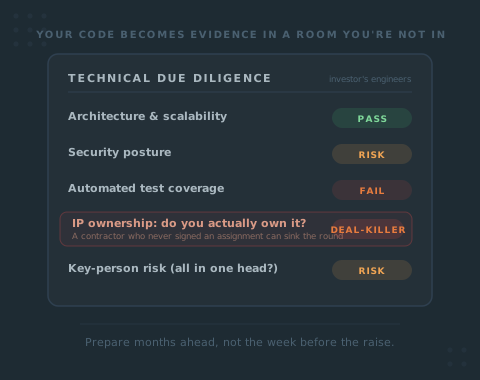
So the engineer works through a checklist that’s remarkably consistent across firms, covering six areas in total, laid out in detail below.
None of this shows up in a demo. That’s the point. The demo is what you built. Due diligence is how you built it, and whether the second thing quietly undermines the first.
The demo answers “does it work today.” Due diligence answers “will it still be standing after you take our money, hire fast, and put ten times the load on it.” Those are different questions, and only one of them decides your valuation.
The Six Things on the Checklist
Here’s what each area means in plain terms, and what a bad finding does to the deal.
Architecture and scale. Will the system hold up as you grow, or is it built in a way that needs a rewrite before you can add the next hundred customers. A rewrite is expensive and slow, and investors know it. This is the difference between “we can grow into the money” and “we’ll spend the money rebuilding what we already have.”
Security and data handling. How you store passwords, protect customer data, and control who can access what. If you’re touching health, finance, or anything regulated, this is where a deal can stall for weeks. A single obvious hole here reads as “nobody senior was watching.”
Code quality and tests. Not whether the code is beautiful, but whether it’s maintainable and whether there are automated tests catching mistakes before customers do. Zero tests isn’t automatically fatal, but it tells the engineer that every future change is a gamble, and they’ll write exactly that.
Technical debt. The shortcuts taken to ship fast, still sitting in the code, quietly making everything harder. Some debt is normal and even healthy. A mountain of it means your future velocity is a fraction of what your roadmap assumes.
IP ownership. Can you prove the company owns every line. More on this below, because it’s the one that kills deals outright.
Key-person risk. If the entire product lives in one person’s head, the investor isn’t buying a company, they’re buying that person’s continued goodwill.
Messy code usually reprices. Unprovable ownership and single-person dependency are the ones that make investors walk.
The Findings That Reprice or Kill the Deal
Not all findings are equal. Ugly code is a haircut on your valuation or a condition you fix after closing. A few findings are different in kind: they make investors walk, because they’re risks money can’t quickly buy away.
Red flag
The ownership gaps that stop a wire transfer
A piece of open-source code with a copyleft licence baked into your product can legally force you to give away code you thought was proprietary. A repository, deployment, or service still sitting in a developer’s personal account can lock you out entirely. And any code, including a contractor’s, that was never formally assigned to the company is legally not yours yet, no matter how long ago it was written. Each of these turns a clean close into a legal cleanup, and the leverage is no longer yours.
The other deal-killer is quieter. It’s the codebase that only one person understands. No documentation, no second engineer who’s ever touched the core, no way for anyone to take over. The investor isn’t evaluating a product at that point, they’re evaluating whether one specific human stays healthy, motivated, and employed. That’s not a bet most of them will size up.
The failure mode isn’t usually catastrophic code. It’s that you can’t answer the engineer’s questions with evidence. “We own everything” is not an answer. A signed assignment for every contributor, a licence audit, and accounts in the company’s name are answers. If your only proof is your own word, the report will say so, and “unverified” reads to an investor exactly like “risk.”
The Founder Who Couldn’t Prove He Owned His Own Product
A founder came to us after a round nearly collapsed at the last step. The product worked, the metrics were good, the investors wanted in. Then the diligence engineer asked a simple question: who wrote this, and can you show us they assigned it to the company.
He couldn’t. The first version had been built by a freelancer he found online, paid through an invoice, and parted ways with amicably two years earlier. No contract with an IP clause. No assignment. Just a PayPal receipt and a handshake over email. Legally, meaningful parts of the codebase still belonged to a man he hadn’t spoken to in years.
The deal didn’t die, but it froze. Weeks of lawyers, tracking down the freelancer, negotiating a retroactive assignment while the freelancer, sensing leverage, took his time. The round closed late and on worse terms. All of it avoidable with one paragraph in a contract signed at the start, when it would have cost nothing.
He owned the idea, the brand, the customers, and the revenue. What he couldn’t prove he owned was the code underneath all of it. In diligence, the thing you can’t prove is treated as the thing you don’t have.
This is why owning your code isn’t a paperwork chore for later. It’s the foundation the whole valuation rests on, and it gets tested at the worst possible moment: when the money is finally close enough to lose.
Prepare Months Ahead, Not the Week Before
The founders who sail through diligence aren’t the ones with perfect code. They’re the ones who saw the questions coming and got their evidence in order before an investor’s engineer got to ask.
- Hunting for old contractors to sign assignments under time pressure
- Discovering a copyleft licence in your core, live, during review
- Explaining away zero tests to a skeptical engineer
- One founder who understands the code, unavailable and stressed
- Learning your architecture needs a rewrite from someone else's report
- Every contributor's IP assigned to the company, on file
- A clean open-source licence audit you did on your own terms
- Code, deployment, and services all in company accounts
- Documentation good enough for a new engineer to take over
- Your own honest read on architecture and debt, done first
The move that helps most is getting an independent technical read before you need one. An engineer you trust reviews the same six areas an investor’s engineer will, and tells you the truth while you still have time to act on it. Finding out your architecture won’t scale is survivable when it’s your own diagnosis with months of runway. It’s brutal when it arrives in a stranger’s report the same week you’re trying to close.
I run a company that does exactly this kind of review, so weigh that as you read it. But the logic holds no matter who does it: the point of due diligence prep isn’t to hide the problems. It’s to know them, price them, and have a credible answer ready before someone else finds them for you and controls the story.
If you’re an investor, accelerator, or angel who needs an independent technical view of a portfolio company, see how we support investors with technical due diligence and product leadership.
Reframe the whole thing. Technical due diligence isn’t an exam you pass or fail at the end. It’s a mirror the investor holds up to how you’ve built the company. Everything it reveals was already true. Preparing early just means you’re the first to see it, instead of the last.
Where You’d Stand Today
If an investor’s engineer opened your codebase next week, how much of this could you prove with evidence rather than assurances.
Would your code survive due diligence?
Tick everything that's genuinely true and provable today.
This is the position the frozen-deal founders were in. Start closing these gaps now, while it's cheap and quiet, not during a live round.
Get future guides direct to your inbox
Get these in order early and diligence becomes what it should be: a confirmation, not an ambush. The round closes on the terms you agreed, on the timeline you planned, because there was nothing buried for anyone to find.
Read next Is My Product Actually Ready to Launch?