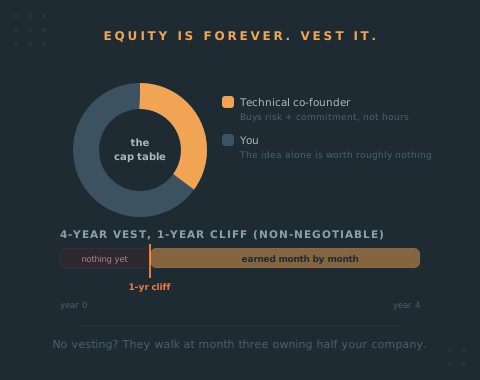

The short version
Equity buys risk-taking, long-term commitment, and skin in the game, not hours. A genuine co-founder building the product with you is meaningful double digits, often near equal. An early employee is low single digits. An advisor is a fraction of a percent. Vesting over four years with a one-year cliff is non-negotiable. And your idea, with no build behind it, is worth roughly nothing. Match the equity to the real role, not the title.
Give a technical co-founder 40% on a handshake, and if it falls apart six months later, you don’t get a single point of it back. Not one. That’s the trade you’re actually making, and most founders make it before they understand it.
Equity is the most expensive currency you have, and unlike cash, you can’t earn more of it. There’s a fixed 100% of your company, it never grows back, and every point you hand over is gone for the life of the business. So spend it like it’s forever, because it is.
Founders ask “how much equity does a technical co-founder get” as if there’s one number. There isn’t. The right answer depends entirely on what the person is actually doing and what they’re actually risking. Here’s the honest map, including the deals we’ve watched go wrong.
Rough ranges. The role and the risk decide the number, not the job title.
What Equity Actually Buys
Equity is not payment for work done. Get this clear before you give any away, because almost every expensive mistake starts by getting it wrong.
Equity buys three things: risk-taking, long-term commitment, and skin in the game. It’s the reward for someone building alongside you for years, often for below-market pay, with a real chance the whole thing is worth nothing at the end. That’s what you’re compensating. The risk, not the hours.
If what you need is hours, pay cash. Equity is what you give someone for taking the risk with you, not for showing up and doing the work. Those are different transactions, and confusing them is how founders end up with a stranger owning a third of the company.
The tell is simple. Ask yourself: is this person betting their next few years on my company succeeding, or are they doing a defined job for defined money? If it’s the second one, that’s a contractor or an employee, and equity is the wrong tool. You wouldn’t pay your electrician in shares of your house. Same logic.
The Real Ranges, With Honest Context
The ranges above aren’t arbitrary, so here’s what actually moves you within them, rather than the numbers again.
A genuine co-founder lands toward the top of their range when they join before there’s a product or funding, work full-time, and take on the same risk you are. Who brought the idea, who’s full-time, who put in money, and how much is already built by the time they join, all push the number up or down. If they’re there at the start, carrying the same risk you are, “equal” is usually the right instinct, and splitting hairs to claw back a few points from the person building the entire product is usually false economy.
A late technical hire is not a co-founder. This is where founders get burned, and it’s one of the most common equity mistakes we see. Someone who joins after you’ve raised, after there’s a product, after most of the risk is gone, doing employee work with a co-founder title, does not get co-founder equity. The title is not the job. Pay them like the senior early employee they are.
An early employee or an advisor moves within their range based on seniority and how early they joined, not on how the title sounds on a deck. A senior first engineer earns more than a junior one; a hands-on advisor earns more than a name that shows up once a quarter. The title is negotiable. The timing and the risk aren’t.
The single most useful question when someone asks for equity: “What are you risking that a salary wouldn’t cover?” A true co-founder is risking years of their life and market-rate income on your success. If the honest answer is “not much,” you’re looking at an employee or an advisor, and the equity should reflect that.
Kill the “My Idea Is Worth 50%” Myth
You will be tempted to believe your idea is the valuable part and the build is just execution. It’s the reverse, and clinging to it is the fastest way to lose a good technical partner.
An idea with no build behind it is worth roughly nothing. Not as an insult, as a fact about where value comes from. Nobody funds a concept. Investors fund traction, working product, and evidence that people want the thing. All of that lives in the execution, and execution is overwhelmingly what a technical co-founder brings. The idea is the cheap part, and anyone good enough to build your product already knows it.
Red flag
The '90/10 because it's my idea' opening offer
Founder opens with “I’ll give you 10% because the idea is mine and mine is worth 90.” Any technical partner worth having hears that and leaves, because they know the idea is the easy part and they’d be doing nearly all the actual value creation for a tenth of it. The founders who insist on this either never find a real co-founder or end up with someone who couldn’t get a better offer. Neither is the outcome you want.
Value the build. If your idea genuinely carries extra weight, because you brought money, existing revenue, or a real head start, that adjusts the split by a few points. It does not justify keeping 90% while someone else creates the product.
Vesting Is Non-Negotiable
If you take one thing from this article, take this. Nobody gets equity without vesting. Not your best friend, not your brother-in-law, not the brilliant engineer you’re desperate to lock in. Nobody.
The standard is a four-year vesting schedule with a one-year cliff. They earn nothing for the first twelve months. Hit the one-year mark and 25% vests at once, then the rest vests monthly over the following three years. Leave before the cliff and you walk away with zero. That’s the point.
Vesting is not you saying “I don’t trust you.” It’s you saying “if this doesn’t work out, neither of us wants the person who left holding half the company.” Any real co-founder understands that instantly. The ones who fight vesting are telling you exactly why you need it.
Get all of it in writing before serious work starts: the split, the vesting schedule, and an IP assignment clause so everything built belongs to the company. The same rules that make a good dev contract protect a co-founder deal, and the founders who skip the paperwork are the ones who end up in the story below.
Here’s the story that should scare you into it. You hand a technical co-founder 50%, no vesting, on a handshake. Month three, it isn’t working, they lose interest, they walk. They still own half your company. Forever. Every dollar you raise, every hour you grind for the next decade, half the upside belongs to someone who left before the product shipped. No investor will touch a cap table like that, and you can’t fix it without their signature, which they have no reason to give.
And don’t assume vesting alone makes you safe: I’ve watched a clean, properly-vested 50/50 split still leave a departed co-founder holding roughly 20% dead equity that made the next raise brutal to close. Vesting protects you from the total disaster. It does not make giving away half the company a decision you can take lightly.
A departed co-founder holding equity they didn’t earn is a dead company walking. We’ve come into cap tables frozen exactly this way, and there’s no clean way to unfreeze them. The dead-equity problem sinks more early startups than bad product ever does, and it is entirely preventable with a document you sign on day one. If equity is already promised without vesting, fix it before you raise a cent, because after that it’s someone else’s decision too.
Match the Equity to the Real Role
The whole game is refusing to hand co-founder equity to someone doing employee work. Line up what the person actually does against what you’re actually paying, and the answer usually gets obvious.
- Joined early, before there was a product or funding
- Full-time, below-market pay, betting years on the outcome
- Owns the technical direction and the risk that comes with it
- Shares the downside if it fails, not just the upside if it wins
- Joined after raise, product, and most of the risk were gone
- Market salary, defined scope, defined timeline
- Executes decisions rather than owning the whole technical bet
- Walks away whole if it fails, because they were paid in cash
Left column earns meaningful equity. Right column earns a salary and maybe a small options grant. The title someone negotiates does not move them between columns. The actual risk and commitment do.
And be honest about the option that doesn’t cost equity at all. At Hurricane we run a technical-partner model: we lead and build the product, take real ownership of the technical side, and take little or no equity to do it. When your product is a standard SaaS, marketplace, or app, and what you need is capability rather than a lifelong 50/50 partner, that’s often the better trade, because you keep the equity for when it actually buys you something.
But I’ll be just as honest about when giving equity away is still the right call. If the technical innovation is the product, deep tech, hard ML, hardware, biotech, or you genuinely need one person maximally committed and aligned for the next five-plus years, a real co-founder with a real double-digit stake is worth every point. In that case, don’t be stingy. Underpaying the person the whole company depends on is a false saving. The mistake isn’t giving away equity. It’s giving it to the wrong role.
Is this person a real co-founder, or an employee with a title?
Tick each one that genuinely describes them and the deal.
This is employee or contractor work. Pay a salary and a small options grant, and keep your co-founder equity.
Get future guides direct to your inbox