
The short version
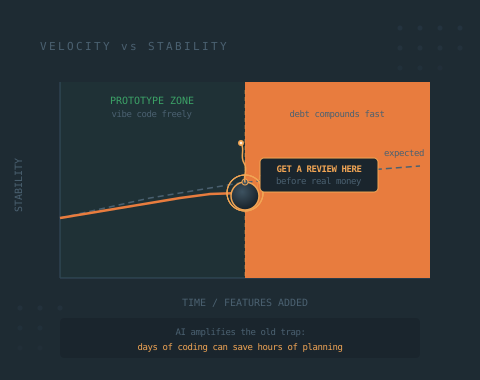
Vibe coding is genuinely good for proving an idea fast. The trap is that working and scalable look identical from the outside. AI amplifies the old 'days of coding saves hours of planning' problem: you can now build a month of wrong architecture by Tuesday. The fix isn't to stop using AI tools. It's to get a technical review before real money, real users, or real data gets involved.
There’s an old saying in software: days of coding can save hours of planning. It’s ironic on purpose. Developers skip the design phase, write code for a week, and end up solving the wrong problem. The rework costs more than the planning would have.
AI didn’t fix this. It made it faster.
You can now generate a week’s worth of wrong architecture in an afternoon. The problem compounds with every new feature you add on top of it. By the time you notice something is broken, you’ve built a month of product on a cracked foundation, and the AI keeps building, confidently, in the wrong direction.
This isn’t an argument against using AI tools to build your MVP. I use them. They’re genuinely useful. But there’s a moment, a specific, identifiable moment, when the rules of the game change. Miss it, and you’ll pay for it in the worst possible way: after you’ve got real users, real data, and real money on the line.
This guide is about finding that moment before you hit it.
When Vibe Coding Your MVP Actually Works
Most “AI coding” takes are either uncritical hype or reflexive dismissal. Neither is honest, and neither is useful.
Vibe coding is excellent for exactly one thing: proving an idea has merit before you invest seriously in building it properly. For that specific job, it’s the best tool available.
You can go from an idea to something you can put in front of real people in days. Not weeks, not months. Days. That speed changes what’s possible for non-technical founders. You can test three versions of an idea in the time it used to take to build one. You can get a paying customer before spending serious money. You can see what people actually do with a product, rather than what they say they’ll do.
That’s real. Don’t let anyone take it from you.
The mistake isn’t using AI to build your MVP. The mistake is scaling the thing you built with AI as if it were production software.
The tools that make this possible have gotten genuinely good. Here’s an honest picture of what each is for.
The Tools, Honestly
Not all AI coding tools are the same. There are two fundamentally different categories, and understanding which you’re using matters.
Chat-based AI: ChatGPT, Claude, Gemini
These are the invisible vibe coding stack. Most non-technical founders don’t think of pasting errors into ChatGPT as “vibe coding,” but it is. You hit a problem, paste it in, get a fix, paste the fix back. It works. You move on.
This is fast and it’s fine, with one structural problem: each session starts completely fresh. Three different chats give you three different approaches to the same problem. They often contradict each other. Your codebase becomes a patchwork of different AI opinions with no consistent logic underneath.
ChatGPT is where most founders start. Broad knowledge, good at explaining errors in plain English.
Claude handles larger amounts of code better and tends to explain the reasoning behind a fix rather than just giving you the code. That matters if you’re trying to understand what you’re building.
Gemini is increasingly built into Google Workspace, so founders stumble into it. Same category.
The hard limit on all three: they only see what you paste. They can’t see the rest of your codebase, so advice that’s technically correct in isolation often breaks something else in context.
Agentic tools: Claude Code, Cursor, Windsurf
These are a different category entirely. Claude Code runs in your terminal and can read and write your actual files, refactor across multiple files, run tests, and read your error logs. Cursor and Windsurf do similar things inside an IDE.
The output quality is meaningfully higher than chat-based AI. But the blast radius of a bad instruction is also much larger. A bad ChatGPT prompt wastes 10 minutes. A badly specified Claude Code instruction can restructure your authentication system before you notice.
Full-stack platforms: Replit, Lovable, Bolt, v0
Replit runs and deploys the whole thing in a browser tab. Lower ceiling, but you can hand someone a working URL in an hour without touching a terminal.
v0 and Bolt are strong on UI. Give them a description and they’ll produce a clean-looking front-end fast. They’re shallow on back-end logic.
Lovable sits between the two. Good for simple CRUD apps (forms, dashboards, basic user accounts) built without any developer setup.
Any of these combined with a real database backend (like Supabase) is what lets non-technical founders build apps with actual user data. It’s also where the most invisible security problems come from.
The more autonomous the tool, the higher the ceiling and the more damage a bad instruction causes. Chat AI wastes time. Agentic AI can make structural mistakes that are hard to reverse.
The Compounding Problem
Here’s what most articles about vibe coding miss.
AI generates new code based on what already exists. If the foundation has a bad pattern, that pattern gets replicated across every new feature. You don’t get a gradually improving codebase. You get a consistently flawed one that keeps getting larger.
This is the “wrongly instructed AI generates more of nothing, or more bad” problem. Each feature you add on top of a broken foundation makes the foundation harder to fix.
You build auth
Works fine. You move on without knowing there's a misconfiguration that lets users access each other's data under certain conditions.
You add 4 features
All four depend on auth working correctly. The AI builds them confidently on top of the flawed foundation.
You add payments
Now you're storing financial data inside a system with a security hole. The AI has no idea this is a problem.
A user finds the bug
Or a security researcher does. Or you do, during investor due diligence. Six features need to be rebuilt, not one.
There’s another version of this that’s less dramatic but equally damaging: the codebase reaches a state where things work but nobody knows why. You can’t change anything safely. Every new feature is a guess. The AI starts giving you contradictory advice because the existing code is internally inconsistent.
This is called technical debt, and AI doesn’t reduce it. It accelerates it. Every feature you add on top compounds how long future changes take, and with AI tools, you can build a month of wrong architecture in days.
Red flag
'It works but I don't know why'
This is the most common state for a vibe-coded app after a few months of active development. It means you’re frozen. You can’t extend it confidently, you can’t fix the thing underneath without breaking the things on top, and the AI’s next suggestion is as likely to make it worse as better.
What Actually Breaks When You Scale
Why a Vibe-Coded MVP Can Become a Liability
A vibe-coded MVP is an asset when it’s doing its job: proving an idea. It becomes a liability the moment you start building real business on top of it without a technical review. The code works, but it was never designed for production, and the gap between “working” and “production-ready” is invisible until you hit it at scale.
This is the section I wish someone had shown founders before they hit these problems. These are specific, concrete, and all invisible until the moment they aren’t.
Security problems you can’t see
Users can see each other’s data. This is the most common one, and it’s invisible until someone notices. AI-generated apps frequently skip or misconfigure the permissions layer that controls who can access what. Any signed-in user can query any other user’s data. Your app looks completely normal. It’s a data breach waiting to happen.
API keys in front-end code. AI-generated code regularly puts secret keys (your OpenAI key, your Stripe key, your database credentials) directly in front-end JavaScript. That code runs in every user’s browser. Anyone who opens developer tools can see your keys. Every user who signs up has them.
No rate limiting. Without it, someone can hammer your endpoints continuously: running up your API costs, scraping your entire database, or attempting automated attacks. Takes one afternoon to do serious damage.
Database problems that only show up at volume
No indexes. A database query that returns in 20 milliseconds with 500 rows can take 8 seconds with 500,000. AI doesn’t add indexes because they’re not visible in a demo. You won’t notice until you have real traffic.
Schema designed for now, not for what comes next. The structure of your database is the hardest thing to change later. Once you have real data in it, migrations become painful. AI builds for the current feature, not for the next six months.
No migration system. Every schema change is manual, undocumented, and done directly against your production database. One mistake deletes real user data.
Architecture problems
N+1 query problem. Fetching a list of 50 items and then making a separate database call for each one. Works fine at 50 items. At 5,000 items it makes 5,001 database calls and your page takes 30 seconds to load.
Everything in one function. Common in AI-generated code. Works fine. Becomes unmaintainable the moment you need to change one thing without breaking three others.
No error logging. When something breaks in production, you find out when a user emails you. You have no visibility into what failed, when, or why.
The Decision Point
Here’s the framework that matters. Vibe coding has two legitimate phases and one dangerous transition.
- You're testing if the idea has merit
- You're building for yourself or a small group to give feedback
- No real user data is being stored
- Nothing irreversible is happening (payments, contracts, personal data)
- You haven't promised anyone that this is a real product yet
- First paying customer is close or already happened
- You're storing any sensitive data (health, financial, personal info)
- You're preparing to raise investment
- You want to add features that depend on the existing architecture
- You're about to start marketing seriously and acquire real users
The transition between these two states is the moment. Most founders miss it because the app looks the same before and after. Once you’ve crossed it, the question of whether your product is actually ready to launch becomes urgent. Users can’t see the difference between a prototype and a production system. The difference lives entirely in what happens when something goes wrong.
The old trap was: skip the thinking, spend days coding the wrong thing. AI didn’t fix that trap. It just made you fall into it faster.
The right response at the transition point is not a rewrite. Almost never. It’s a targeted technical audit.
What a Technical Review Actually Covers
A good technical review of a vibe-coded app takes 2-3 days. It’s not a rewrite and it’s not a judgement on the work done so far. It’s a structured look at seven specific things.
1. Auth and access control. Can users see each other’s data? Is the permissions layer configured correctly? Are sessions handled securely?
2. Exposed secrets. Are any API keys, database credentials, or secret tokens accessible from the browser or version control?
3. Database schema. Will this structure survive the next six months of features? Are the relationships modelled correctly? Is there a migration system in place?
4. Query performance. What do the slowest queries look like? Are there indexes? What happens to them at 10x current volume?
5. Cost modeling. What does the infrastructure bill look like at 1,000 users? At 10,000? Are there any operations that scale non-linearly in cost?
6. Error monitoring. Is anything set up so you know when things break? Sentry, logging, alerts.
7. The one thing that breaks first. Every system has a weakest point under load. Find it before your users do.
The output isn’t a list of everything wrong. It’s a prioritised list: what needs fixing before you scale, what can wait, and what’s actually fine.
The vibe-coded version of your product is also a functional spec. Engineers can see exactly what you built and what you want. That’s more useful than a written brief. You’re not starting from scratch. You’re cleaning up and hardening what already exists.
There’s one more thing worth knowing: the founders who delay this review until after they’ve raised, after they’ve acquired serious users, or after their first security incident pay much more than the cost of the review. In time, in engineering work, and sometimes in the trust of their customers.
Get the review done at the transition point. Not after. Here’s how we run these reviews with founders.
Is it time to get a technical review?
Mark anything that applies to your current situation.
You're probably still in safe prototype territory. Keep building and validating.
Get future guides direct to your inbox