
The short version
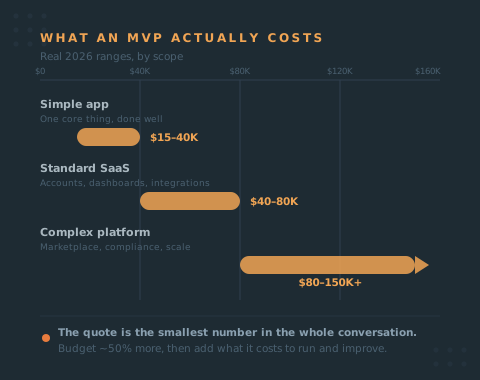
Realistic MVP costs: $15-40K for simple apps, $40-80K for standard SaaS, $80-150K+ for complex platforms. The cheapest option usually costs the most in the end. Budget 50% more than the quote, and remember the MVP isn't the finish line, it's the first version of a thing you'll keep paying to run and improve.
Ask three teams to quote the same MVP and you’ll get three numbers that barely seem to describe the same project: $18K, $65K, $140K, for a spec that didn’t change between calls. Nobody explains the gap, so you’re left guessing whether the low number is a steal or a trap, and whether the high number is quality or just overhead.
Here’s a straight answer, with real ranges, and what actually drives the number. Then the part that usually gets left out: the quote is the smallest, most misleading number in the whole conversation.
Real 2026 ranges for a genuine MVP built by competent people. Not marketing numbers.
Which Bracket Are You In?
Most founders overestimate which tier they need. Your first version is almost certainly simpler than the picture in your head.
Simple ($15-40K). One main thing, done well. A booking tool. A directory with payments. A content app with logins. Real product, real users, narrow scope. If you can describe the whole thing in two sentences without the word “and” appearing four times, you’re probably here.
Standard SaaS ($40-80K). The big middle. User accounts, a dashboard, a couple of third-party integrations (payments, email, maybe a calendar), different permission levels, an admin view. Most B2B tools that founders picture live here.
Complex ($80-150K+). Two-sided marketplaces, anything touching regulated data (health, finance), real-time features, heavy integrations, or serious scale from day one. If your MVP has to be compliant or connect a lot of moving parts, the floor is high and there’s no honest way around it.
The fastest way to cut cost isn’t finding a cheaper team. It’s cutting scope. Every founder who came to us over budget wanted to build the standard-SaaS version of a simple-app idea. The most valuable thing a good partner does early is talk you out of features, not into them.
What Actually Moves the Number
When two quotes for “the same thing” differ by 3x, it’s usually one of these four things, not one team gouging you.
Complexity. Features, integrations, edge cases, and compliance. Each integration is a small project with its own failure modes. “Just add payments” is never just.
Who’s writing it. A senior engineer costs more per hour and less per outcome. They build the thing once, in a way the next person can maintain. A cheaper junior builds it two or three times, and you pay for all three. Seniority is the single biggest hidden variable in any quote.
Speed. Want it in six weeks instead of twelve? That costs more, because it means more people working in parallel, which means more coordination overhead. Rush pricing is real and it’s not a scam.
Who you’re buying from. An agency prices to finish a project and move on. A technical partner prices to live with the thing. Those are different incentives that produce different code, and the difference doesn’t show up in the demo. It shows up in month four.
The quote answers “what does it cost to build version one?” That’s not the question you actually care about. The question you care about is “what does it cost to end up with a product that works and that I can keep improving?” Those two numbers are rarely close.
The Cheapest Quote Is a Trap More Often Than a Deal
I run a company that competes on quality, so read this with the appropriate salt. But I’m telling you this because I’ve been the person cleaning it up, four times.
When someone quotes half of everyone else, it’s almost never because they found magic. It’s because the price is set on the visible things (the screens, the demo) and paid for by cutting the invisible things: architecture, security, documentation, testing. You can’t see any of those in a demo. You feel all of them six months later, at the worst possible time.
Red flag
What 'cheap' actually costs
Every rescue project we’ve taken on started as the cheap option. Undocumented code nobody but the original author can touch. Security shortcuts that became a problem the moment real users arrived. Architecture that couldn’t handle the second feature, let alone the tenth. In each case the “expensive” quote they turned down would have cost less than the cheap build plus the rebuild. They paid twice, and lost the months in between.
A health-tech company is the cleanest example I have. They spent roughly six months with their first agency with no end in sight: a backend nowhere near done, built the hard way instead of on services that already existed. We rebuilt it in three months, and this was before AI tooling. They paid for two builds and lost half a year in between. The cheaper first quote turned out to be the most expensive line in the whole budget.
This cuts both ways. Overpaying doesn’t buy quality either. A big agency name and a big number is not proof of anything except a big overhead you’re funding. The goal isn’t cheapest or most expensive. It’s the honest middle, from people who can explain what you’re paying for.
If you’re not sure how to tell a real team from a good salesperson, that’s a skill you can build without being technical.
Budget for the Real Thing, Not the Quote
Here’s the reframe that helps most. The quote is the cost of version one. The product is the thing you actually need. They are not the same purchase.
- The build quote, as a fixed, final number
- Nothing after launch
- Zero scope change once you see it working
- Hosting and services as an afterthought
- The quote, plus roughly 50% for scope you can't foresee yet
- Ongoing cost to run it: hosting, email, payments, third-party services
- Money set aside to change things once real users touch it
- A plan to keep improving it, because v1 is where the learning starts
The 50% buffer isn’t pessimism. It’s what happens every time: you see the thing half-built, you realise the flow should work differently, users do something you didn’t predict. That’s not failure, that’s the entire point of building an MVP. But it costs money, and founders who didn’t budget for it end up shipping something they already know is wrong because they’re out of runway.
The most expensive moment in a build is running out of money at 80% done. You’re left with something that doesn’t work yet and no budget to finish. Protect against this by scoping smaller and keeping reserve, not by finding a cheaper team to stretch the same money over more features.
A Fair Deal, in Plain Terms
You’re getting a fair price when: the number lands in a believable range for your tier, the team can explain what drives it, the scope is written down and small enough to actually finish, payment is tied to working software you can use rather than time elapsed, and nobody’s promising you the complex-platform feature set for the simple-app price.
You’re being set up when: the quote is dramatically below everyone else’s, the scope is vague enough to argue about later, billing is hourly with no cap, and every question about what’s included gets a reassuring wave instead of an answer.
Cheap, fast, good. You get to pick two, and anyone promising all three is lying about at least one. The only real question is which one you’re quietly giving up, and whether you chose it or they chose it for you.
The founders who get this right aren’t the ones who found the lowest number. They’re the ones who understood what the number was for, scoped it down to something honest, and kept enough in reserve to survive the surprises. Do that, and the price stops being a gamble.
Before you sign anything, ask the team in front of you to walk you through what drives their number, not just what the number is. A price nobody can explain is the real red flag, more than the price itself. Pick a fair number for the tier you’re actually in, set the extra 50% aside instead of spending it, and you’ve done more to protect this build than any amount of shopping around ever will.
If you’d rather have someone sanity-check a quote with you, that’s a conversation we’re happy to have, no pitch attached. We’ve seen where these go.
Read next Why Your Last Agency Failed (And How to Not Repeat It)