
The short version
A fractional CTO's most valuable function is not technical. It's being a clear sounding board for the CEO: someone who says 'do not do this' before you sink months of time and money into the wrong direction. They balance business, budget, team, and technology simultaneously. The best ones make technical debt visible before it becomes a crisis. Most things sold as 'fractional CTO' are actually advisors who aren't present enough to catch your pivots.
The best engineer I ever worked with would have been a terrible CTO. Could hold an entire distributed system in their head, wrote code the rest of us had to read twice to follow. Also the first person to go heads-down on the hardest technical problem in the room and the last to notice the business had changed direction. That’s not a knock on them. It’s just a different job.
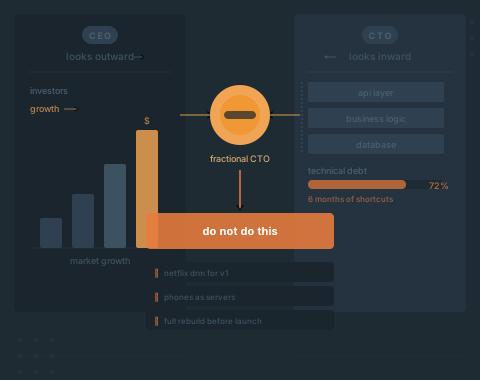
A CTO, fractional or not, doesn’t sit at the engineering end of the table. They sit in the middle of four things at once: Business, Budget, Team, and Technology. I keep calling it B2T2 in my head (like some human version of R2D2). Not a dignified acronym, but it’s accurate. The moment someone optimizes hard for one of those four, the other three start going wrong.
What founders usually need isn’t better engineers. They need someone whose job is to sit in that middle and say: this is not the right direction, and here’s why.
That’s what a fractional CTO is actually for. Not the technical skills. The position.
What a Fractional CTO Actually Does
Most people think a fractional CTO is a part-time senior engineer who makes technology decisions. That’s part of it, but it misses what makes the role actually valuable.
A good early-stage CTO doesn’t need to be the best engineer in the room. They often aren’t. What they need to be is the person who can hold B2T2 in their head simultaneously and make sensible tradeoffs between all four at once.
The CEO looks outward: market, investors, deadlines, growth, the next round. The CTO looks inward: stability, maintainability, the technical debt accumulating silently with every shortcut. These are genuinely different jobs, and the startup that treats them as a hierarchy rather than a partnership tends to end up optimizing for the wrong one.
The CTO’s most valuable function isn’t technical. It’s being the person who says “we should not do this” and can explain clearly why, in terms a founder can act on.
Technical decisions don’t exist in isolation. Every choice made under time pressure, every shortcut taken to get to launch, every “we’ll fix this later”. It doesn’t disappear. It stays in the codebase. In software, this is called technical debt, and like any debt, small amounts are manageable. Ignore it long enough and the interest compounds until you’re spending more maintaining the old thing than building the new one.
A fractional CTO keeps that debt visible. They’re the person who says: “This is fine now. But if we do it this way, here’s what it costs us in six months.” That clarity, delivered consistently and early, is what founders are actually paying for.
The Questions That Actually Protect You
The practical work is real: technical direction, team hiring or management, translating between engineering reality and business requirements, representing the tech side in investor conversations.
But the part that doesn’t make it onto job descriptions is the willingness to question the brief itself.
“Do you really need all of this for the first version?”
“What happens if we get this wrong?”
“This will take three weeks to build and two days to throw away if the assumption is wrong. Can we test the assumption first?”
A lot of technical partners, agencies, and developers accept briefs without question. There’s no malice in it. Agencies have a natural incentive to take the work. Developers want to do their job well and build what they’re asked. But nobody in that dynamic is responsible for asking whether the thing being built is the right thing.
That question is the fractional CTO’s job. It’s also the hardest version of it to find.
Red flag
What a bad brief looks like
Founder arrives with a vision for year five: Netflix-level content protection, live streaming, integrations with every device on the market, a community platform, all for version one. Two agencies quoted one to three years of work. Neither said “you don’t need most of this yet.” The founder spent months and significant budget before starting over with a simpler version that should have been the plan from day one. A good technical partner asks the hard question before the contract is signed.
The Problem With Technical Advisors
“Fractional CTO” and “technical advisor” get used interchangeably. They’re not the same thing, and the difference matters.
An advisor gives input when asked. They’re not in the day-to-day, not in the Slack channel where the real decisions happen, not present when the pivot happens or when a constraint quietly changes. So their advice, even when it is excellent, is based on the business as it was when they last engaged with it. Early-stage startups pivot constantly, and a business that looks similar from the outside can be fundamentally different six months later. Neither of you notices the guidance has gone stale until a decision built on it goes wrong.
The fractional CTO who is in your conversations regularly enough to understand the current context, not the archived one, is the one whose advice is actually worth acting on.
How It Differs From Everything Else
- Technical advisor: opinions on request, calibrated to old context
- Agency: executes the brief, rarely questions whether it's right
- Strong developer without leadership instincts: builds correctly, wrong thing
- Fractional CTO who only directs: strategy with no one to execute it
- Full-time CTO too early: 150K+ salary and equity before you need daily presence
- Someone present enough to catch the pivots as they happen
- Someone accountable for whether you're building the right thing, not just how
- Someone who asks 'which problem are we solving?' before 'what should I build?'
- At early stage: strategy and execution together, not separated
- The ability to say 'do not do this', clearly, early, and in terms you can act on
When you actually need a fractional CTO
You have engineers but nobody setting direction. The team is building, features are shipping, but architecture decisions are being made by whoever has the most confidence that day. The codebase is accumulating complexity nobody is managing.
You’re approaching fundraising. Technical due diligence at Series A is real. Investors hire engineers to review your code and architecture. A fractional CTO who has been present for six months can represent that conversation credibly. Someone brought in the week before cannot.
You need someone in the room who can say no. Not as a blocker. A partner who understands the business well enough to tell you when a direction is going to cost you more than it’s worth.
When you probably don’t need one yet
If you have no engineers yet, a fractional CTO who only directs leaves a gap. You need someone who can build as well as lead. At pre-team stage, a technical partner or CTO-as-a-service model is usually a better fit. The question of what kind of technical partner you need is worth thinking through first.
If you’re still pre-product, the overhead of a fractional CTO may not be worth it. Their value scales with the complexity they’re managing. No team, no codebase, no meaningful decisions yet: there isn’t enough to direct.
What Good Looks Like
Most fractional CTOs will tell you they’re excellent. A few things actually separate the useful ones.
The first thing a good one asks about is your business, not your stack. If the first twenty minutes are about what framework you’re using rather than what you’re trying to do and who you’re doing it for, that’s a signal worth paying attention to.
They can translate. Not “we have a microservices architecture experiencing latency under load.” Something like: “We built this in a way that works fine now, but changing it in six months will cost three times what it would cost to fix today.” That translation is half the job.
They push back. A fractional CTO who agrees with everything isn’t providing technical leadership. They’re providing comfort. The ones who say “this is a bad idea, here’s why, and here’s what I’d do instead” are the ones earning their cost.
They’ve operated at your stage before. Technical leadership at seed stage is different from Series B. The skills don’t just scale down. Someone whose only CTO experience is at a 200-person company may have entirely the wrong reflexes for an eight-person startup.
Green flag
One question worth asking in any first conversation
Ask them about a technical decision they made that turned out to be wrong. Someone who cannot recall being wrong, or who attributes every mistake to context outside their control, is someone who is not learning from experience. Someone who can walk you through the mistake, the signal they missed, and what they would do differently: that’s a person who will actually help you avoid making the same one.
What It Costs
At the lower end ($5K to $8K per month), you’re typically looking at one day per week and involvement closer to advisory. At the higher end ($15K to $20K), you’re getting two to three days per week with genuine ownership of technical direction.
Some fractional CTOs charge day rates of $1,500 to $3,000, which works well for project-based engagements: a technical audit, due diligence preparation, architecture review.
Offerings under $3,000 per month are almost always advisory relationships, not leadership ones. You get opinions when you ask, not someone accountable for outcomes. Know which one you’re buying.
For comparison: a full-time CTO in London or New York typically expects $150K to $200K in salary plus equity of 1 to 5 percent. A fractional arrangement at $10K to $15K per month makes financial sense at early stage when you need the strategic function but not daily presence.
The right time to hire full-time is when you’re managing five or more engineers and need someone present every day.
How Hurricane Studio Works
We run a technical partnership model rather than a traditional fractional CTO arrangement. The distinction: we lead and build.
We set technical direction, make architecture decisions, and own the technical side of your product. We also write code and work alongside your team, or build the early team around you. At early stage, the gap between “someone who decides” and “someone who executes” is where startups get stuck. We close that gap.
More practically: we’re the people who say “this is not the right direction” before you’ve spent three months going in it. And we say it in terms you can act on, not in technical language that leaves you more confused than when you started.
That function: being a clear sounding board, saying do not do this, and being present enough to know when the business has changed. That is what we think the role is actually for.
If you’ve got engineers but nobody setting direction, or you’re within six months of fundraising and need technical credibility in the room, that gap is worth closing before it gets more expensive to fix.